Exceptional Place to Live with an Increasingly Competitive Rental Market
Austria regularly features among the world's most liveable and peaceful countries, recognised for its quality of life, safety, strong public services and healthcare – with Vienna consistently ranked at the very top of global city liveability surveys. Vienna has held first or second place in every major international liveability ranking for the past decade. In 2024, the Mercer Quality of Living survey noted a slight decline in Vienna's position, citing reduced availability of suitable rental properties for international assignees. That observation is telling – and it is precisely what this overview addresses.
The private rental market in Austria has shifted significantly in recent years. Finding the right apartment now requires clearer expectations, sharper timing and a better understanding of how the market actually works. This post explains what has changed, why, and how to approach your search effectively.
We have also written a companion post with essential renting tips for international residents and a dedicated explainer on the Bestellerprinzip reform – both worth reading alongside this one.
How Austria's Rental Market Got Here
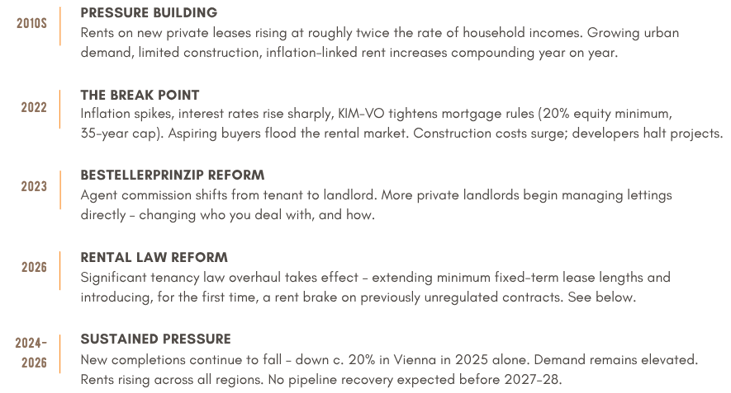
Pressure on Austria's private rental market has been building for some time. Through the 2010s, rents on new private leases were rising at roughly twice the rate of household incomes – a gap driven by growing urban demand, limited construction and an inflation-indexation system that regularly ratcheted rents upwards. The private market was already tightening before anyone called it a crisis.
From 2022, the pressure became acute. A combination of sharp inflation, rapidly rising interest rates and tightened mortgage lending rules made homeownership financially out of reach for a large segment of people who had previously been potential buyers. They did not stop needing a home – they moved into the rental market instead, substantially increasing competition for an already constrained supply. At the same time, construction costs surged and developers across Austria halted or cancelled planned projects. Three consecutive years of falling new completions have followed.
Understanding What You Will Actually Pay in Rent
If you have been researching rents in Austria, you may have come across the Statistik Austria figure of €10.40/m² – the average rent including operating costs across all rental tenancies in Q4 2025. It is a legitimate number, but it is likely to give you a false sense of what to expect when you start searching.
That figure covers all 1.8 million existing rental contracts in Austria. Around two-thirds of those are in the social and regulated sector – municipal apartments, cooperative housing and regulated older private stock – where rents are legally capped and tenants have often been in place for a decade or more. This brings the average down significantly.
As a newcomer to Austria, you are unlikely to be eligible for social housing. Municipal apartments require a minimum of two years' registered residence before you can even apply; cooperative apartments have their own waiting lists and criteria. The market you will actually be searching is the private rental market – lettings advertised on platforms like ImmoScout24 and Willhaben, where rents are set by supply and demand.
Here the picture looks quite different. The national median advertised rent reached €15.20/m² in 2025. In Vienna, it was €21.00/m² – roughly double the headline Statistik Austria figure.
That is not a discrepancy. It is simply two different measures of two different markets. The ImmoScout24 figures are the relevant reference point for your search.
Recent Advertised Rents Across Austria
The table below shows median advertised rents by federal state. Rents rose in almost every region in 2025, and the gap between the most and least expensive states remains stark.
Vienna and the western states of Tyrol, Salzburg and Vorarlberg are consistently the most expensive and have seen the strongest sustained increases. If you have flexibility on location, cities like Graz (c. €13.40/m²), Linz (c. €12–13/m²) and St. Pölten (c. €12.80/m²) offer considerably lower costs without sacrificing quality of life or infrastructure.
Within Vienna, the map below shows how 2025 price changes played out across all 23 districts. Neubau (7th) surged 41% to €26.30/m², driven by a tiny handful of high-specification new builds arriving in a district with very limited existing stock. Brigittenau (20th), Landstraße (3rd), Hietzing (13th) and Hernals (17th) all rose more than 20%. By the end of 2025, only five districts still had advertised rents below €20/m²: Favoriten, Simmering, Rudolfsheim-Fünfhaus, Floridsdorf and Liesing.
How the Market Has Changed
Beyond the price rises, the structure of the private rental market has changed in ways that directly affect a new arrival's ability to find and secure a property.
The Bestellerprinzip reform of July 2023 shifted agent commission from tenant to landlord. In response, many private landlords chose to manage lettings themselves rather than engaging a professional agency. From our experience handling property searches since the reform, we are now seeing approximately a 50:50 split between working directly with private landlords and with professional property management companies, where previously it was almost entirely the latter.
A private landlord and a professional agency operate very differently. An agency follows a standardised process. A private landlord sets their own terms, often has no fixed application procedure and makes decisions quickly based on personal impression – usually formed through a conversation in German. In our experience, these allocation decisions involve not just practical criteria – income, employment stability, documentation – but also a personal gut feeling about reliability and fit. For someone approaching from abroad without an Austrian rental history, without German and with unfamiliar paperwork, that informal dynamic is significantly harder to navigate.
The low vacancy rate makes timing critical. In a market where well-priced properties receive hundreds of enquiries and let within days, a private landlord has neither the obligation nor the incentive to respond to most applicants. When a house seeker sends an enquiry in English to a private landlord who did not ask for English, they are already further back in the queue before the conversation has started. And when an applicant takes time to consider a property, or negotiates harder than the market warrants, the apartment often goes to someone who moved faster or asked for less. In a market with vacancy at 1.5–2%, availability is the constraint – not price.
Around half of all rental listings in Austria are fixed-term contracts (befristete Mietverträge) – and in Vienna, that figure rises to approximately 70%, stable for the past three years. From 2026, professional landlords must offer a minimum term of five years rather than three, though private landlords retain the three-year minimum.
For a new renter, this matters: the type of landlord you are dealing with — professional management company or private individual — now determines not just how your application is handled, but the minimum length of the contract you will be asked to sign. Understanding what your contract says about term, indexation and the new rent brake is more important than it used to be, which is another reason to have it reviewed properly before you sign.
How Working with Recom Changes Your Odds
No one can guarantee you will find the right apartment. The market is competitive and the process more demanding than it was a few years ago. What we can tell you is that having the right support substantially increases the likelihood of a good outcome – and reduces the risk of mistakes in the contract.
Access and Preparation
We search across listing platforms, agency relationships and direct private landlord networks – including properties that never appear in a public search. We invest real preparation: we make contact in German, introduce our clients properly and manage the relationship from the start. To a private landlord, the presence of an established relocation company is a known, verifiable entity – which matters when the alternative is an unknown individual approaching in a foreign language.
Presenting Your Candidacy
We know what Austrian landlords look for in a tenant. We help clients assemble the right documentation, frame their situation clearly and approach negotiations in a way this market requires. We manage expectations honestly: what the market currently offers, where flexibility is worth showing and where it is not. Many clients come to us after trying independently. We listen to what went wrong and approach the search differently.
Austrian rental negotiation is more measured and relationship-dependent than in many cultures. We understand that, and we help clients navigate it with the cultural awareness that comes from doing this every day.
Contracts and Clarity
Austrian rental contracts have long-term consequences – and the 2026 legislative changes have added complexity around minimum terms, indexation clauses and the new rent brake. We review every contract in detail, translate the key clauses and make sure our clients sign with complete clarity about what they are committing to.
Both sides benefit from that level of clarity, and a landlord who has worked with Recom before understands exactly what that process looks like.
Working with Recom substantially increases the probability of finding and securing a suitable property – but no outcome can be guaranteed in a competitive market. What we can promise is professional, honest support at every stage.
Looking Ahead
Mortgage lending rules were eased in mid-2025 and some demand may gradually return from renting to buying. But no meaningful increase in rental supply is expected before 2027-28 – and the Austrian real estate industry association ÖVI stated plainly in late 2025: "We believe the supply situation will not improve in the next two years."
The 2026 legislative reforms offer some relief on rent increases and more security of tenure, but they do not fix the fundamental supply shortage – and advertised rents on new lettings remain on an upward trajectory.
Austria's cities remain exceptional places to live and work. The quality of life has not changed. What has changed is the effort required to secure your home here – and understanding that clearly is the best preparation of all.
|
|
Talk to us about your moveWe'll give you an honest picture of the current market and what to expect for your specific situation. 
|
|